Your cart is currently empty!
You may check out all the available trips and book one that suits you.
Continue Browsing Trips
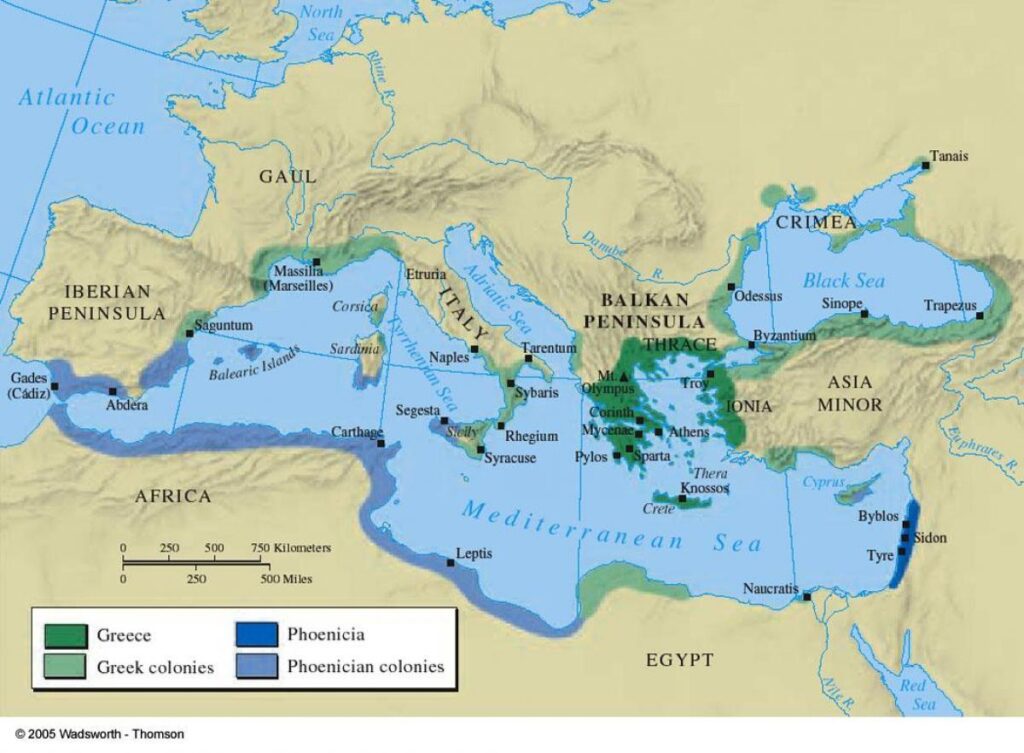
Long before Rome existed as anything more than a village on the Tiber, the ancient Greek colonies had already spread across the entire Mediterranean — from the coast of Spain to the shores of the Black Sea. Between roughly 800 and 500 BC, Greek city-states founded around 500 colonies involving as many as 60,000 settlers, and by the end of that period, colonists living outside mainland Greece made up nearly 40% of the entire Greek world.
This wasn’t a single organized campaign. It was centuries of individual city-states — Corinth, Chalcis, Miletus, Megara, Sparta — each sending out groups of settlers for their own reasons: too many mouths to feed at home, a search for farmland and metal ore, or simply the pull of trade routes that promised wealth. Greek mythology itself remembers this restless streak — Jason sailing for the Golden Fleece, Odysseus wandering the length of the Mediterranean on his way home from Troy. Long before any formal colony existed, small groups of merchants and adventurers had already been testing the waters, quite literally, up and down the coastlines of the known world.
It is not a secret that the word Barbarian came out at that period, as the Greeks were having problems understanding the language of native tribes, so they kept saying, ” What do they say? “VA VA VA.’
It’s tempting to think of ancient Greek colonization the way we think of 19th-century colonialism — a homeland dominating distant territory by force. The reality was messier, and in most cases, far less one-sided. Some Greek settlements became fully independent within a generation or two, developing their own governments, their own identities, sometimes even rivaling the city that founded them. Syracuse, founded by Corinth in 733 BC, eventually grew into the largest city anywhere in the Greek world — bigger than Corinth itself, and wealthy enough to fund its own wars and its own fleet. Other settlements blended so thoroughly with local populations that they became something new entirely, neither fully Greek nor fully indigenous, with mixed customs, mixed languages, and mixed bloodlines within a few generations.
Historians increasingly describe this as “culture contact” rather than colonization in the modern sense — a slow process of trade, intermarriage, and gradual settlement rather than outright military domination. That said, it wasn’t peaceful everywhere. Where good land and safe harbors were scarce, Greek settlers sometimes fought hard to displace or subjugate the people already living there, and conflicts with rival colonizing powers — especially the Phoenicians and later the Etruscans — were a recurring feature of the whole expansion.
The establishment of ancient Greek colonies throughout the Mediterranean allowed the export of many goods, such as vintage Greek pottery, wine, oil, metalwork, and textiles, as well as the production of wealth from the land – for example, timber, metals, and agricultural products (especially cereals). dried fish, and hides) – and often became lucrative trading hubs and a source of slavery.
A metropolis could establish a colony in order to establish a military presence in an area and thus protect lucrative sea lanes. In ancient Greece, colonies were also a vital bridge for domestic trade opportunities. Some colonies even managed to compete with their metropolises. Syracuse, for example, gradually became the largest city in the entire Greek world. Finally, it is important to note that the Greeks did not have the field free. Rival civilizations also formed colonies, especially the Etruscans and the Phoenicians, and sometimes, inevitably, war broke out between these great powers.
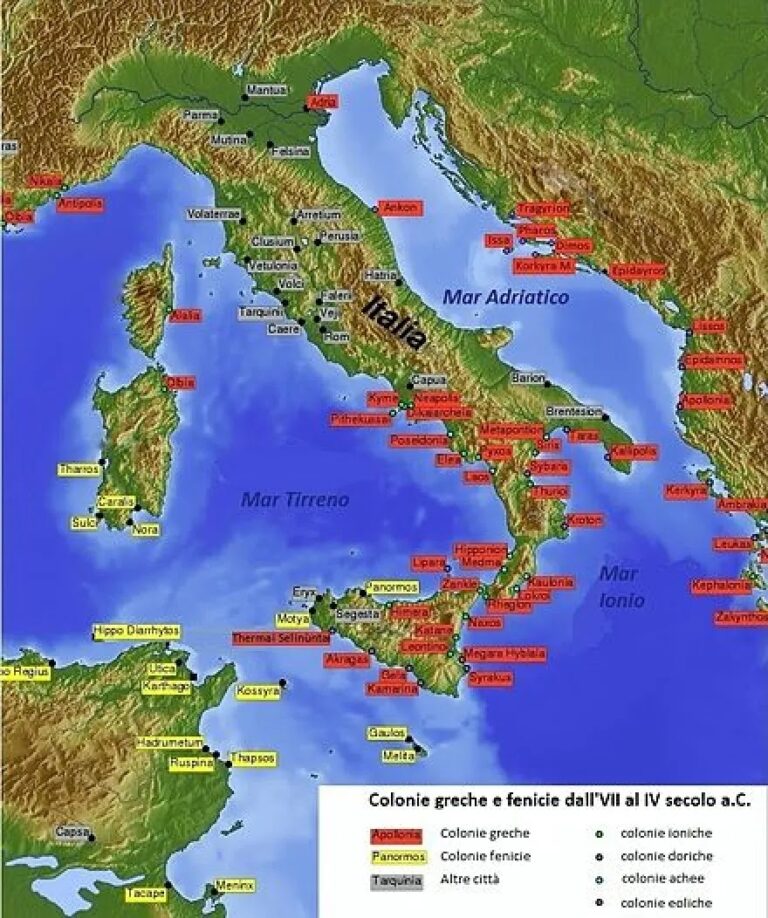
Southern Italy and Sicily attracted Greek settlers earlier than almost anywhere else, drawn by fertile land and good harbors. The Greek presence became so dominant here that later writers called the region Magna Graecia — Greater Greece — and it would remain the most thoroughly Hellenized of all the colonized territories, both culturally and architecturally. Its Doric temples, many still standing today, are some of the best-preserved examples of Greek architecture anywhere in the world, arguably better preserved than many temples in Greece itself.
Cumae, founded around 740 BC, was the first Greek settlement in Italy. It was followed by Naxos (734 BC), Croton, and Taras — founded by Spartan settlers in 706 BC, in one of the rare cases of Sparta sending colonists abroad at all. Sicily saw the rise of Syracuse, Gela, and Akragas, cities wealthy enough that the philosopher Empedocles, himself from Akragas, joked that its citizens “revel as if they must die tomorrow, and build as if they would live forever.”
If you’ve taken our Ancient Corinth tour, you’ve already stood in the city that launched Syracuse — one of the most consequential colonial ventures in Greek history, and proof that a colony could eventually outgrow its own founder.

Across the Aegean, on the coast of what’s now Turkey, Greek settlers built Miletus, Ephesus, and Smyrna starting in the 8th century BC. Ionia became something unexpected: a meeting point between Greek and Near Eastern culture, absorbing artistic styles, decorative motifs, and ideas from Persia, Lydia, and beyond. It’s not a coincidence that some of the earliest Greek philosophers and mathematicians — Thales, Anaximander, Pythagoras — came from this region. Ionia’s position between worlds made it fertile ground for genuinely new ways of thinking, unburdened by the more conservative traditions of the mainland.

Phocaea, a city on the Ionian coast, pushed further west than almost any other Greek city, founding Massalia — modern Marseille, around 600 BC, along with a scattering of trading posts along the Spanish coast, including Emporion. These western colonies never fully absorbed Greek culture the way Magna Graecia did. Competition with Phoenician traders, who had reached Spain and North Africa generations earlier, was constant and often hostile, and mainland Greek writers treated the region as a distant, half-known frontier rather than a true extension of the Greek world.

The last great wave of ancient Greek colonization pushed north and east into the Black Sea, chasing fertile grain-growing land and rich fishing grounds around the Hellespont. Miletus alone was credited with founding as many as 70 settlements, including Sinope and Pantikapaion. Megara added Byzantium — the city that would one day become Constantinople, then Istanbul — in 668 BC. Athens later took a strategic interest in the region too, since Black Sea grain shipments became essential to feeding the growing Athenian population during the 5th century BC, particularly once local agriculture could no longer keep up with demand.

What held this scattered world together wasn’t political control — most colonies answered to no one but themselves. It was culture: a shared language, shared myths, shared festivals like the Olympic Games at Olympia and the Pythian Games at Delphi, and constant trade in wine, olive oil, and pottery between cities that might be separated by a thousand miles of open sea. A temple built in Sicily could look remarkably similar to one in Ionia, built by architects trained in the same traditions, even if they had never set foot on the Greek mainland.
That’s the real legacy of the ancient Greek colonies — not an empire in the modern sense, but a shared civilization stretching from Spain to the Crimea, whose traces are still visible today in the ruins scattered across a dozen modern countries, from the temples of Sicily to the Black Sea coast of Bulgaria and Ukraine.
Around 500 colonies, home to as many as 60,000 Greek settlers. By 500 BC, these territories represented roughly 40% of the entire Greek world.
Across the Mediterranean and beyond — southern Italy and Sicily (Magna Graecia), Ionia on the coast of Asia Minor, southern France and Spain, and the Black Sea region.
The Greek colonies of southern Italy and Sicily, considered the most culturally Greek of all colonized regions. Syracuse, founded by Corinth in 733 BC, eventually became the largest city in the entire Greek world.
Yes — Miletus alone was credited with founding as many as 70 colonies there, including Sinope and Pantikapaion, with Megara founding Byzantium in 668 BC.
It’s generally described as cultural contact rather than domination. Many colonies became fully independent, sometimes strongly Greek in character and sometimes blending closely with the indigenous cultures they settled among.