Your cart is currently empty!
You may check out all the available trips and book one that suits you.
Continue Browsing Trips
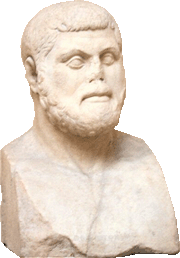
Themistocles, son of Neoklis, was born around 527 BC and died in 461 BC in Persia. In the beginning, he didn’t have any political rights, as his mother was from Thrace and not an original Athenian. Thanks to statesman Kleisthenes (founder of Democracy), who changed that law, Themistocles started his political career.
He was one of the generals in the battle of Marathon in 490 BC, leading his tribe (Athens had 10 tribes). After the glorious win in Marathon, Miltiades, the chief commander of the battle, took all the glory. For years, Themistokles had Miltiades as his hero, but he also wanted to become a bigger hero than him. History recorded his phrase, “ Glory of Miltiades doesn’t let me sleep at night’
He was the only politician in Athens saying that the Persian threat is still alive. He tried to convince the Athenians to build a strong navy in order to face the Persians, but nobody was listening to him, saying as an excuse that the cost was tremendous.
And here starts to show his amazing skills, he funded a theatrical theme which was showing the destruction of the city of Militos by the Persians. That started to scare the Athenians, actually, he was the first to use the social media of his time for his goal!!
Then, he used the lower classes of Athens to vote against his political rivals, and he succeeded, all of them were ostracised for 10 years from the city.
Now, Themistocles had to convince his fellow citizens to build a navy. How could he do that? The King of Sparta changes, and the new one starts to support the island of Aegina instead of Athens. Themistocles starts a conflict with Aigina’s navy,y knowing that they fight better at sea.
Athens loses the naval battle, and Themistocles finally convinces the Athenians to give their share of the silver mines of Lavrion in order to build 200 battleships.
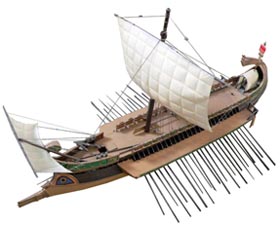
When the second Persian campaign was started by King Xerxes, Themistocles advised the other generals (from the Greek alliance), and especially the Spartan king Evryviades, to sail all Greek ships to Artemisium to face the Persian fleet in the narrow sea of Artemisium, while the Spartans would hold the ground forces of Xerxes in Thermopylae.
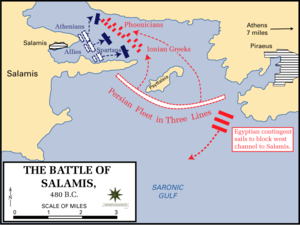
The Greek ships were 366, while the Persians were 1204, plus around 3000 smaller supply boats. They didn’t have any chance to face them on open seas, only in a narrow area. After Thermopylae’s defeat, the Spartan king says to make a defense in the Corinth Canal area, which meant the full destruction of Athens. Themistocles, using the oracle of Delphi, tells the Athenians to leave the city and move to Salamis Island.
While arguing in the generals’ council with Evryviades, he says to him another famous phrase, “ hit me but listen to me’ to the Spartan king who wanted to hit him. That convinced Evryviades to face the Persians in Salamis.
While both fleets were standing, some city-states wanted to break the Greek alliance. In the Persian camp, the Phoenicians (well experienced at sea) were saying to Xerxes that the position of Salamis was very dangerous and they must face the Greek ships on the open sea.
Seeing this situation, Themistocles sent his personal slave to Xerxes to inform him that the Greeks were arguing, and now was the right moment to attack. Xerxes believed him and ordered the attack. With this move, he united the Greek alliance and trapped the Persians.
After the Persian defeat, the Golden Age of Athens began. Themistocles finished the fortification of Athens, cheating the Spartans who were against the walls.
Unfortunately for Themistocles, the Spartans’ influence in Athens made him ostracised from the city. Knowing that his life is in danger, he went to the Persian king Artaxerxes, who welcomed him well and treated him with great respect.
In 461, the Persian king asked Themistocles to lead his army against the rebellion of the Egyptians, who had made an alliance with Athens against the Persians. Refusing to betray his country, Themistocles drank bull’s blood and committed suicide. His body was transferred in secret to Athens and buried with great honors.
His tomb is in Piraeus, and everybody can visit it.
Thanks to Themistocles, the Greeks won the biggest empire of that time. Definitely, with his defeat, all the light that Greek civilization gave to the world would be missing without him.
Stand where this story unfolded: our Marathon tour from Athens visits the battlefield of 490 BC, and our Cape Sounion tour tells the story of the Lavrion silver that built Themistocles’ fleet.
Convincing Athens to build a powerful navy using silver from the Lavrion mines, and then engineering the Greek victory at the Battle of Salamis in 480 BC by tricking Xerxes into attacking in the narrow straits, where the smaller Greek fleet had the advantage.
“Strike me, but listen to me” — spoken during a heated argument in the Greek generals’ council when the Spartan commander threatened to hit him. It worked, convincing Eurybiades to fight the Persians at Salamis rather than retreat.
After being ostracized from Athens due to Spartan influence, he fled to Persia, where King Artaxerxes received him with great respect. When later asked to lead a Persian army against Athens’ ally Egypt, Themistocles refused to betray his country and took his own life by drinking bull’s blood, around 461 BC.
His body was secretly transferred back to Athens and buried with great honors. His tomb is located in Piraeus and remains open to visitors today.
After the defeat at Thermopylae, Themistocles used the Oracle’s guidance to convince the Athenians to abandon their city entirely and evacuate to the island of Salamis, setting up the decisive naval battle that followed.