Your cart is currently empty!
You may check out all the available trips and book one that suits you.
Continue Browsing Trips
The best tour for a day in Athens is one that moves with purpose, covers the ground that actually matters, and leaves enough room to eat well and get lost in the right neighbourhood. If you only have one day in Athens, the decisions you make in the first hour determine everything. The city has more to offer than a single day can hold — but with the right itinerary and a local who knows the city, one well-spent day gives you more than most people manage in three days on their own. Here is exactly how to use it.
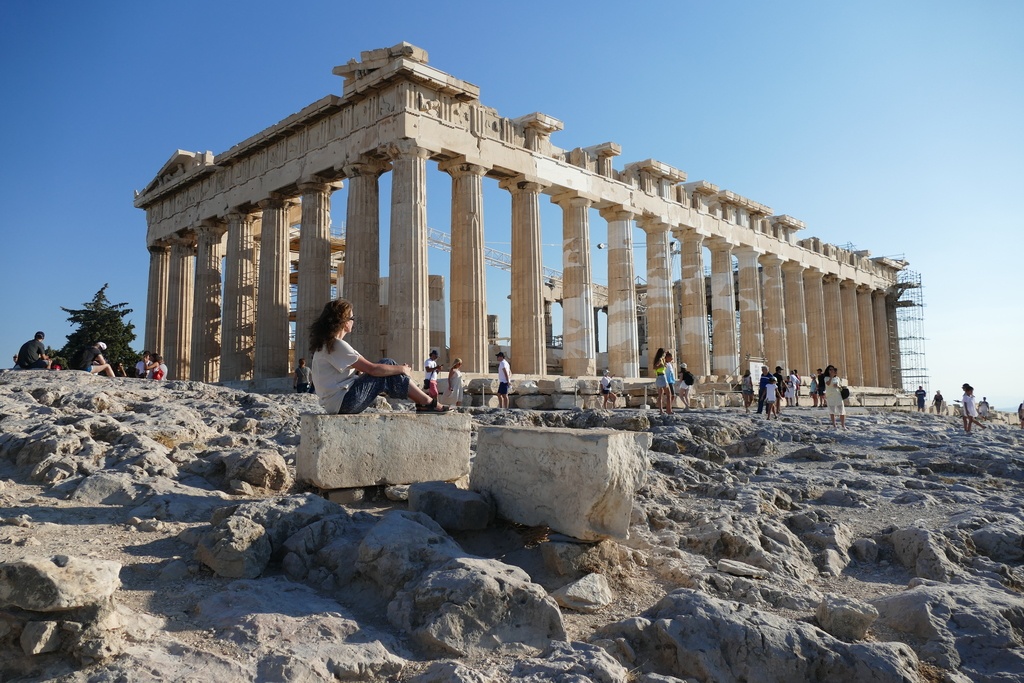
The best tour for a day in Athens starts early, and it starts here. The Acropolis opens at 8 am, and arriving in the first hour makes an enormous difference — the site is quieter, the light is better for photographs, and the heat is manageable even in summer. By 10 am, the first coach groups begin arriving from Piraeus cruise ships, and the experience changes significantly.
Built under Pericles between 447 and 406 BC by the architects Iktinos and Kallikrates under the artistic direction of Phidias, the sacred precinct is the finest surviving example of classical Greek architecture on earth. The Parthenon, completed in 432 BC, remains the most studied building in history — its columns lean subtly inward, its stylobate curves almost imperceptibly upward, all calculated to make the structure appear perfectly proportioned from any angle. The Erechtheion with its Porch of the Caryatids, the Temple of Athena Nike, and the Theatre of Dionysus, the world’s first theatre, where Sophocles and Aristophanes premiered their plays for audiences of up to 17,000, complete a site that rewards every minute you give it.
Below the Acropolis, the Areopagus — Mars Hill — is where the Apostle Paul preached to Athens in 51 AD. The view of the Parthenon from that rock is one of the best in the city and takes two minutes to reach. Don’t skip it.
Book your Acropolis tickets online in advance, in summer, timed entry slots sell out, and arriving without a ticket costs you an hour of your single day.
Directly below the hill, the New Acropolis Museum opened in 2009 and is widely regarded as one of the finest archaeological museums in Europe. It was built specifically to house the sculptures from the Acropolis above, with the top floor aligned precisely with the Parthenon, so you can study the surviving frieze sculptures in natural light while the monument itself is visible through the glass behind them. The original Caryatids — five of the six — are displayed at eye level so you can stand beside them. Budget at least 90 minutes here.
From the museum, the tour moves through the landmarks that define classical and modern Athens. The Ancient Agora — the marketplace and civic heart of ancient Athens, where Socrates argued daily, is anchored by the Temple of Hephaestus, the best-preserved ancient temple in Greece, its columns and frieze intact after 2,500 years. The Panathenaic Stadium, built entirely of white Pentelic marble and host to the first modern Olympic Games in 1896, is a genuinely moving place to stand. The Temple of Olympian Zeus, with its 15 surviving Corinthian columns each 17 meters tall, Hadrian’s Arch, and the changing of the Evzone guards at Syntagma Square complete the classical circuit.
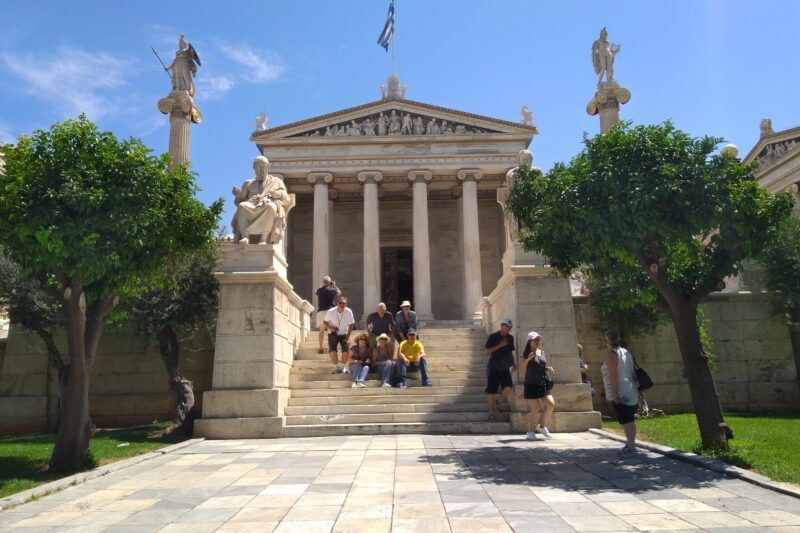
The Athens Trilogy — the University, the Academy of Arts and Sciences, and the National Library, designed by Danish architect Theophil Hansen in the 19th century — lines one of the most architecturally distinctive streets in Europe and takes ten minutes to pass through on the way to lunch.
The afternoon belongs to the neighbourhoods. Plaka, the oldest continuously inhabited neighbourhood in Athens, and Monastiraki offer the most concentrated authentic street-level experience of the city: Byzantine churches, neoclassical houses, the flea market, and the ancient Agora just around the corner. This is where you have lunch, wander without a plan, and let the city settle in.
For those who want to go deeper into Athenian food culture, the Athens food tour runs in the afternoon and covers the Varvakios Central Market — operating since 1886 and the largest fresh fish market in Europe, alongside 15+ authentic tastings at spots where locals actually eat. Combining the morning sightseeing tour with the afternoon food tour is the most complete single-day Athens experience available.
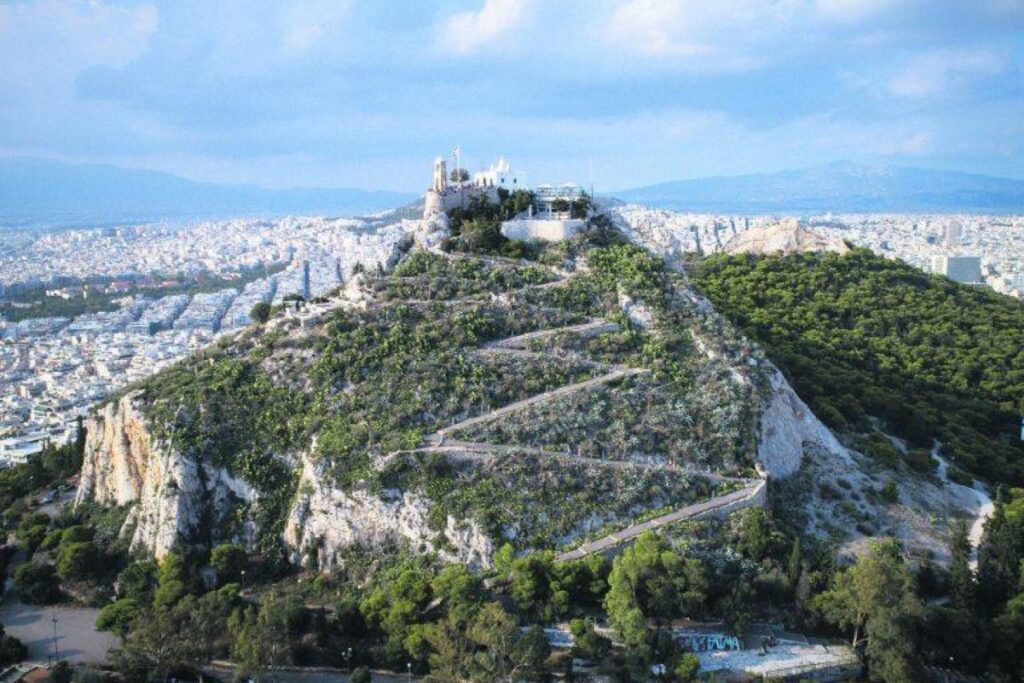
Before dinner, Lycabettus Hill — at 277 meters, the highest point in Athens, almost double the height of the Acropolis — offers the best panoramic view of the city, particularly at sunset. The Acropolis sits below you to the southwest, the Saronic Gulf catches the last of the light to the south, and the entire city spreads out in every direction. It takes fifteen minutes to reach the summit by funicular or on foot, and it is worth every one of them.
With only one day, the gap between a private tour and exploring independently is at its widest. A local who knows the history doesn’t just identify monuments — they explain why the Parthenon’s architects built deliberate imperfections into a structure designed to appear perfect, what Socrates was actually accused of, and why the Evzone uniform carries 400 pleats in its skirt. That context turns a sightseeing walk into a genuine encounter with history.
On a private tour, the pace is yours. Arrive at the Acropolis at the right time, spend longer at whatever moves you most, and arrive at each stop with energy and curiosity intact rather than monument fatigue. For a single day in one of the world’s great cities, it is the right call.
Our full-day Athens tour covers all of the above with hotel pickup and an English-speaking driver who knows the history — the Acropolis, the museum, all major classical landmarks, Lycabettus Hill, and free time in Plaka. One day, one city, done properly.
Arrive right at opening, 8 AM. The site is quieter, the light is better for photos, and it’s more manageable in summer heat. By 10 AM, the first coach groups arrive from Piraeus cruise ships and the experience changes significantly.
At least 90 minutes. The museum was built specifically to house the Acropolis sculptures, with the top floor aligned precisely with the Parthenon so you can view the surviving frieze sculptures in natural light with the monument visible behind them.
Yes, with the right itinerary and a private tour. A well-planned single day covers the Acropolis, the Acropolis Museum, classical Athens (the Ancient Agora, Temple of Olympian Zeus, Panathenaic Stadium), Plaka and Monastiraki in the afternoon, and Lycabettus Hill at sunset.
Lycabettus Hill, at 277 meters the highest point in the city — almost double the height of the Acropolis. It offers the best panoramic view, particularly at sunset, and takes about 15 minutes to reach by funicular or on foot.
For a single day, a private tour makes the biggest difference. Your driver, a local with deep knowledge of history, provides context beyond just naming monuments, and the pace is set by your interests rather than a fixed group schedule — meaning better timing at the sites, more time at what genuinely interests you, and less monument fatigue.