How to get to the temple of Poseidon from Athens
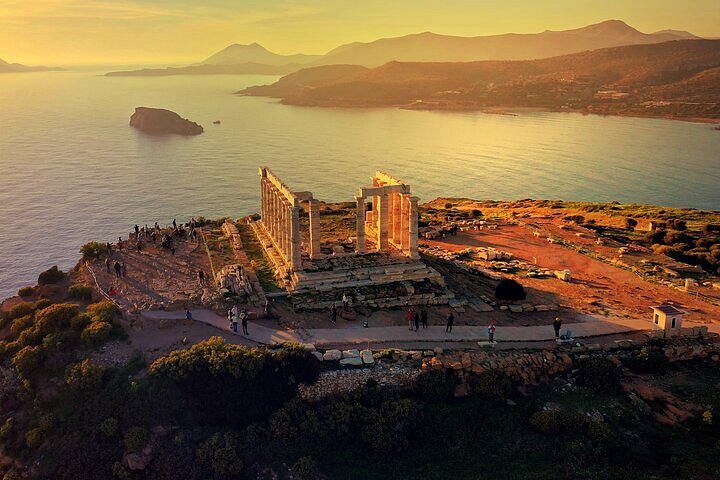
The Temple of Poseidon at Cape Sounion is one of the most dramatic ancient sites in Greece, a marble temple perched 60 meters above the Aegean Sea, 69 kilometres south of Athens, built between 444 and 440 BC on the same headland where King Aegeus threw himself into the sea when he mistook his son Theseus’s black sails for a signal of death. How to get to the temple of Poseidon from Athens is straightforward, and the journey along the Athenian Riviera is half the experience.
Here are your options on how to get to the temple of Poseidon from Athens
Option 1 — Private Tour from Athens (Recommended)
The most rewarding way to reach Cape Sounion is on a private tour from Athens, and the reason is simple: the Temple of Poseidon without context is a beautiful ruin. With a knowledgeable guide, it becomes a story — the silver mines of Lavrion that funded the Athenian fleet, the myth of Aegeus, the Byron connection, the architectural details that most visitors walk straight past.
A private Cape Sounion tour from Athens typically takes half a day, departing in the morning or afternoon and following the coastal road south through the Athenian Riviera — Glyfada, Vouliagmeni, Varkiza — with an optional stop at Lake Vouliagmeni, the thermal lake fed by underground springs that maintains a constant temperature between 22 and 29°C year-round. The tour returns to Athens in the early evening, in time for dinner.
The afternoon departure has one significant advantage: the sunset at Cape Sounion, with the temple columns turning amber against the darkening sky and the Aegean below, is one of the most celebrated views in Greece. Timing your arrival for the late afternoon is worth planning around.
Our Cape Sounion tour covers the temple, the archaeological site, the myth of Aegeus and Theseus, the story of the Lavrion silver mines, and the Byron inscription — with a stop at Lake Vouliagmeni on the way. Private departures available daily from Athens hotels and Piraeus cruise terminal.

Option 2 — Public Bus from Athens
KTEL buses run regularly from the Pedion tou Areos terminal in central Athens directly to Cape Sounion. The journey takes approximately 1.5 to 2 hours, depending on traffic and the route — there are two services, one following the coastal road (recommended for the views) and one taking the inland highway. Buses run roughly every hour during the summer and less frequently in the winter.
The bus is the most economical option and perfectly manageable for independent travellers. The main limitation is timing — the last bus back to Athens departs in the early evening, which means staying for the sunset requires checking the schedule carefully in advance. The bus stops at the car park below the site, from which it is a short walk up to the ticket office.
Option 3 — Driving from Athens
The drive from central Athens to Cape Sounion takes approximately one hour via the coastal road — the same Poseidonos Avenue that runs through the Athenian Riviera. This is the more scenic route and is worth taking even if it adds a few minutes to the journey. Follow signs for Glyfada and Vouliagmeni, then continue south along the coast to Sounion.
Parking is available at the site. The coastal road can be busy on summer weekends, particularly on the return journey in the afternoon — building in extra time is worth doing.

The Silver Mines of Lavrion — Worth Stopping On the Way
Just inland from Cape Sounion lies Lavrion, one of the most historically significant — and least visited — sites on the entire route. From the 6th century BC, the Athenians mined one of the richest silver deposits in the ancient world here, using thousands of slaves to extract the ore. The revenue from these mines funded the construction of the Athenian fleet — the same fleet that destroyed the Persian navy at the Battle of Salamis in 480 BC and saved Greek civilisation. Without Lavrion’s silver, the Temple of Poseidon above it might never have been built.
In the 19th century, the mines were reactivated, and at their peak, Lavrion supported over 40 industrial factories extracting lead, manganese, and zinc. By the mid-1980s, the minerals were exhausted, and the industry collapsed. The Archaeological Museum of Lavrion and the industrial heritage site are worth a brief stop for anyone with a genuine interest in how ancient Athens actually worked.
Practical Information
The Temple of Poseidon is open daily. Entrance costs €20 for adults, with reduced rates for students and free entry for visitors under 18 and over 65. The site is open from 9 am to sunset — arriving at least 90 minutes before closing is advisable to give yourself enough time to explore properly.
Wear comfortable shoes — the path from the car park to the temple involves uneven ground and a moderate climb. Sun protection is essential between April and October. There is a cafe-restaurant at the site with outdoor seating and views over the Aegean, which makes for a natural stop before the return journey.
For those combining Cape Sounion with a full Athens sightseeing day, our Athens and Cape Sounion tour covers both in a single private day trip — the city in the morning, the coastal road and temple in the afternoon.
Is the Temple of Poseidon worth visiting?
Absolutely. The Temple of Poseidon at Cape Sounion is one of the most dramatic ancient sites in Greece, combining stunning Aegean views with 5th-century BC Doric architecture.
How far is Cape Sounion from Athens?
Cape Sounion is approximately 69 kilometres from Athens, about 1.5 hours by car or 2 hours by public bus from Pedion tou Areos square.
Can you swim at Cape Sounion?
Yes! Sounion Beach is just below the temple and is open for swimming during the summer months.
Did Lord Byron visit the Temple of Poseidon?
Yes — Lord Byron visited in 1810 and carved his name on one of the marble columns, which can still be seen today.