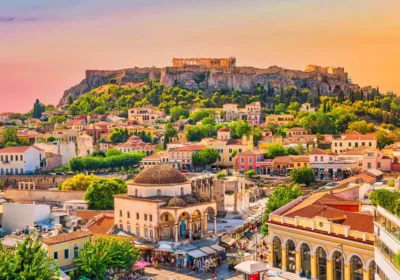
Athens to Delphi Day Trip: The Oracle, the Sacred Way & the Centre of the Ancient World
The Athens to Delphi day trip is the most popular excursion from the Greek capital — and it earns that reputation completely. In one full day, you travel from Athens into the mountains of central Greece, arriving at a sanctuary that was considered the navel of the world for nearly a thousand years, where kings and generals sought divine guidance before making decisions that shaped history. Delphi is a UNESCO World Heritage Site, one of the most dramatically situated ancient sites in Greece, and one of those rare places that exceeds every expectation the moment you arrive.

The Drive — Through Boeotia and Up Mount Parnassus
The journey northwest from Athens takes approximately two and a half hours, passing through the plains of Boeotia — the fertile region of ancient Thebes — before the road begins to climb into the mountains of central Greece. The landscape shifts dramatically as you ascend: open farmland gives way to steep limestone cliffs, pine forests, and the sweeping valley of the Pleistos River far below. The mountain village of Arachova, perched on the slopes of Mount Parnassus just ten minutes from Delphi, is a natural stop on the way — a stone-built village known for its handwoven carpets, local cheeses, and mountain wine, and one of the most charming spots in mainland Greece.

The Archaeological Site — Walking the Sacred Way
Delphi was the most important religious sanctuary in the ancient Greek world. According to myth, Zeus released two eagles from opposite ends of the earth to find its centre — they met at Delphi, and the omphalos stone that marked the spot can still be seen in the museum today. For nearly a thousand years, from the 7th century BC through the Roman period, rulers, city-states, and ordinary citizens made the journey here to consult the Oracle of Apollo — the most influential prophetic voice in the ancient world.
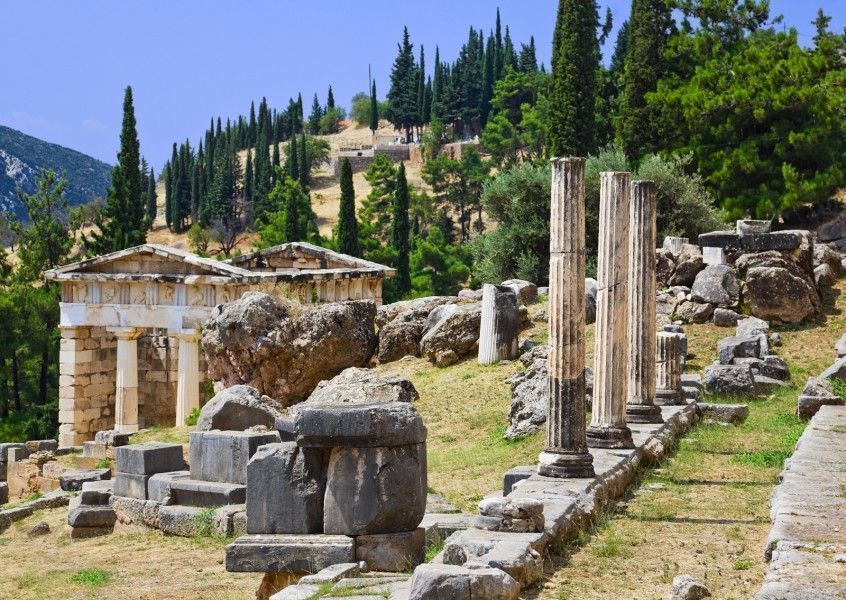
Entering the sanctuary, you follow the Sacred Way — the same uphill path that ancient pilgrims walked — past the treasuries built by Greek city-states as offerings to Apollo. The Treasury of Athens, built around 490 BC from the same Pentelic marble as the Acropolis to celebrate the victory at Marathon, is one of the best-preserved structures on the site.
At the top of the Sacred Way stands the Temple of Apollo itself — where the priestess Pythia sat on her tripod, entered a trance induced by vapours rising from a fissure in the earth, and delivered Apollo’s answers in riddles that shaped wars, political decisions, and the founding of colonies across the Mediterranean. The temple’s influence extended far beyond Greece — even the Persian King Croesus consulted the Oracle before his fateful campaign against Cyrus the Great.
Above the temple, the ancient theatre is beautifully preserved — 35 rows of limestone seats with views across the valley below that make it one of the most spectacular settings of any ancient theatre in Greece. Higher still, the Stadium where the Pythian Games were held every four years — the second most prestigious athletic competition in the ancient world after Olympia — sits at the very top of the sanctuary, largely intact after 2,400 years.

The Tholos of Athena Pronaia
Before or after the main site, the circular Tholos temple — built around 380 BC and dedicated to Athena Pronaia — is one of the most photographed structures in all of Greece. Three of its original twenty Doric columns have been re-erected, and the combination of circular marble architecture against the limestone cliffs and olive groves below the sanctuary creates an image that has become synonymous with ancient Greece itself.

The Delphi Archaeological Museum
Always visit the museum — the context it provides transforms the archaeological site from beautiful ruins into a story you can read. The collection is outstanding. The bronze Charioteer of Delphi, cast around 478 BC, is one of the finest surviving examples of ancient Greek bronze work — the detail of the reins in his hands, the pleats of his robe, the slightly asymmetrical eyes designed to appear straight when viewed from below, are remarkable at any distance.
The colossal Sphinx of the Naxians, the chryselephantine statues of Apollo and Artemis, the sculptural friezes from the Siphnian Treasury depicting the Gigantomachy and the Trojan War, and the omphalos stone itself — the artefact the ancient Greeks believed marked the literal centre of the earth — are among the most significant pieces in any museum in Greece.
After the museum, lunch in the village of Delphi is a natural pause — a small, quiet place with excellent tavernas and views over the olive-covered valley stretching south toward the Gulf of Corinth, where the ancient ships once carried pilgrims from across the Mediterranean to begin their journey to the Oracle.

Why a Private Tour Makes a Difference
The Athens to Delphi day trip covers a lot of ground — the drive, the sanctuary, the museum, Arachova, and the return journey — and the pace matters enormously. On a private tour, your guide adjusts the time at each site to what genuinely interests your group. Spend longer at the theatre if the views stop you. Linger in the museum over the Charioteer. Skip the queue at the ticket office and arrive at the site before the first coach groups. The difference between a rushed group tour and a private day at Delphi is the difference between ticking a box and actually understanding what you came to see.
With more than 20 years of experience leading private tours from Athens to Delphi, we know the site in every season and at every hour of the day. Book your Athens to Delphi day trip and arrive at the centre of the ancient world properly prepared for what it has to offer.